Predicting barotropic tides with FES and pyTMD#
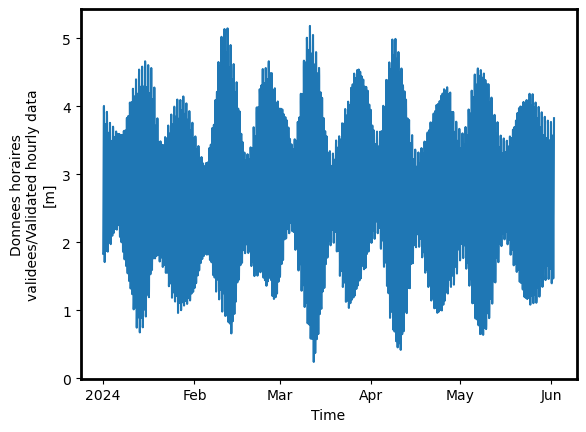
Predictions are verified agains sea level observations from the Bayonne-Boucau tide gauge (DATA.SHOM.FR)
Link to FES data
import os

import numpy as np
import xarray as xr
import pandas as pd

from matplotlib import pyplot as plt

%matplotlib inline

import pynsitu as pin

crs = pin.maps.crs
import pynsitu.tides as td
/Users/aponte/.miniconda3/envs/insitu/lib/python3.10/site-packages/utide/harmonics.py:16: RuntimeWarning: invalid value encountered in cast
  nshallow = np.ma.masked_invalid(const.nshallow).astype(int)
/Users/aponte/.miniconda3/envs/insitu/lib/python3.10/site-packages/utide/harmonics.py:17: RuntimeWarning: invalid value encountered in cast
  ishallow = np.ma.masked_invalid(const.ishallow).astype(int) - 1
load and inspect tide gauge data#
prod = False
tg = xr.open_dataset("data/94_2024.nc")
tg = tg.rename(Source4="sea level", TIME="time")

# extract lon/lat
lon_tg, lat_tg = float(tg.LONGITUDE), float(tg.LATITUDE)

# area of interest
extent = [-3, -1, 43.2, 44.5]
plot_map = lambda: pin.maps.plot_map(extent=extent, land=True, coastline=False)

# time = pd.date_range(start="2023/03/01", end="2023/08/01", freq="30T")
time = pd.to_datetime(tg.time)
tg["sea level"].plot()
[<matplotlib.lines.Line2D at 0x13d548f40>]
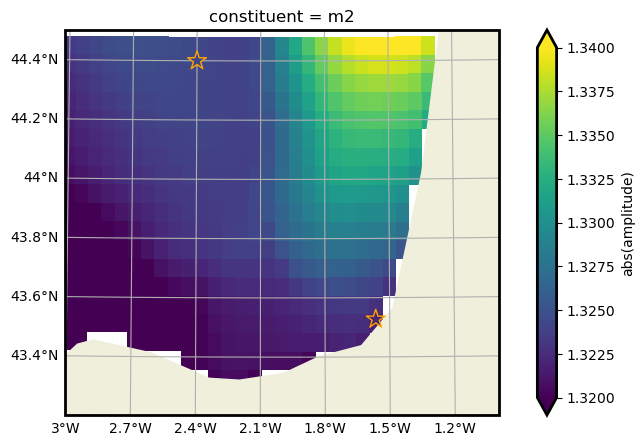
harmonic amplitudes in the area of interest#
# positions of interest
moorings = dict(
    bayonne=[lon_tg - 0.05, lat_tg],  # offset tide gauge to be in water
    offshore=[-2.4, 44.4],
)
mo = (
    pd.DataFrame(moorings)
    .T.rename(columns={0: "lon", 1: "lat"})
    .to_xarray()
    .rename(index="mooring")
)
# output 2d grid
dl_min = 0.0625  # potential resolution: 0.0625
lon, lat = (extent[0], extent[1], dl_min), (extent[2], extent[3], dl_min)  # cp area
# load sea level and semi-diurnal constituents only
vtype = "z"
csts = td.major_semidiurnal
ds_2d = td.load_tidal_amplitudes(lon, lat, vtype, constituents=csts)
ds_moorings = td.load_tidal_amplitudes(mo.lon, mo.lat, vtype, constituents=csts)
broadcasting lon/lat
vmin = 1.32
vmax = 1.34

c = "m2"

# fig, ax = plot_map()
fig, ax, _ = plot_map()

_ds = ds_2d.sel(constituent=c)
(
    np.abs(_ds[vtype + "_amplitude"])
    .rename("abs(amplitude)")
    .plot(
        x="lon",
        y="lat",
        vmin=vmin,
        vmax=vmax,
        ax=ax,
        transform=crs,
    )
)

_ds = ds_moorings.sel(constituent=c)
h = ax.scatter(
    _ds.lon,
    _ds.lat,
    c=np.abs(_ds[vtype + "_amplitude"]),
    s=200,
    edgecolors="orange",
    marker="*",
    # _ds.lon, _ds.lat, c="w", s=100, edgecolors="0.5",
    vmin=vmin,
    vmax=vmax,
    transform=crs,
    zorder=10,
)
# load on FES grid - needs update
# ds = td.load_raw_tidal_amplitudes(["z", "u", "v"], lon=lon, lat=lat, constituents=td.major_semidiurnal)
# ds.sea_level_phase.sel(constituents="m2").plot()
# np.real(ds.sea_level_amplitude*np.exp(1j*ds.sea_level_phase*np.pi/180)).sel(constituents="m2").plot()
store all tidal harmonics#
# prod = True
prod = False

nc = "bayonne_mooring_harmonics.nc"
if prod:
    ha = td.load_raw_tidal_amplitudes(["z", "u", "v"], lon=lon, lat=lat)
    ha.to_netcdf(nc, mode="w")
else:
    ha = xr.open_dataset(nc)
tidal predictions#
just sea level and (m2, s2)#
# just m2 and s2
ds = td.tidal_prediction(
    mo.lon,
    mo.lat,
    time,
    [
        "z",
    ],
    constituents=td.major_semidiurnal,
    minor=False,
    split=True,
)
ds
<xarray.Dataset> Size: 206kB
Dimensions:       (mooring: 2, time: 3672, constituent: 2)
Coordinates:
  * mooring       (mooring) object 16B 'bayonne' 'offshore'
  * constituent   (constituent) object 16B 'm2' 's2'
    amplitude     (constituent) float64 16B 0.2441 0.1127
    phase         (constituent) float64 16B 1.732 0.0
    omega         (constituent) float64 16B 0.0001405 0.0001454
    alpha         (constituent) float64 16B 0.693 0.693
    species       (constituent) float64 16B 2.0 2.0
    omega_cpd     (constituent) float64 16B 1.932 2.0
  * time          (time) datetime64[ns] 29kB 2024-01-01 ... 2024-06-01T23:00:00
Data variables:
    lon           (mooring) float64 16B -1.565 -2.4
    lat           (mooring) float64 16B 43.53 44.4
    z_tide        (mooring, time) float64 59kB -1.423 -1.311 ... 0.6056 0.8539
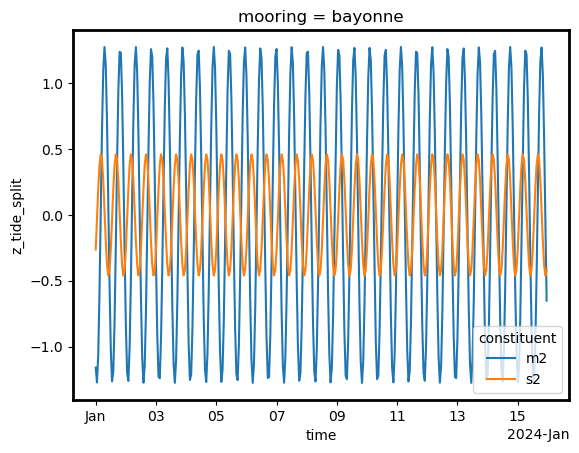
z_tide_split (mooring, constituent, time) float64 118kB -1.16 ... -0.419individual constituent contributions#
tlim = ("2024/01/01", "2024/01/15")
da = ds["z_tide_split"].sel(mooring="bayonne", time=slice(*tlim))
da.plot.line(hue="constituent")
[<matplotlib.lines.Line2D at 0x15af81ae0>,
 <matplotlib.lines.Line2D at 0x15af364d0>]
total sea level prediction#
# prod = True
prod = False

# with full list of harmonics
nc = "bayonne_moorings_time_series.nc"
if prod:
    tp = td.tidal_prediction(mo.lon, mo.lat, time, split=True)
    tp.to_netcdf(nc, mode="w")
else:
    tp = xr.open_dataset(nc)
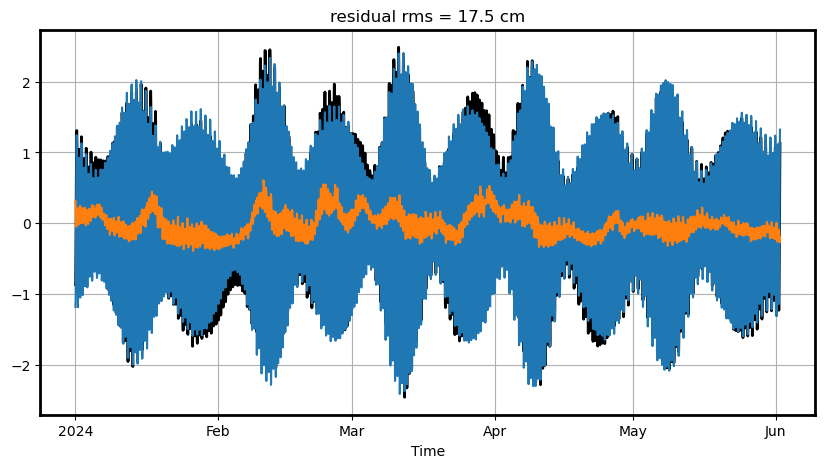
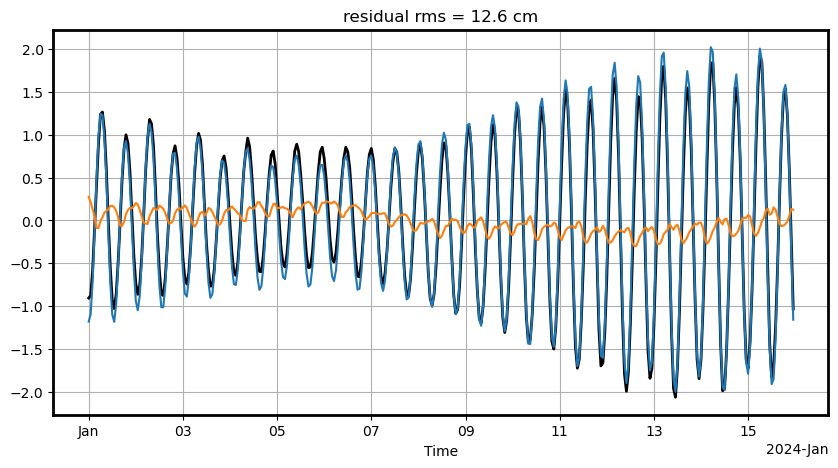
def plot_tseries(tg, tp, tlim=None):

    fig, ax = plt.subplots(1, 1, figsize=(10, 5))

    da = tg["sea level"]
    if tlim is not None:
        da = da.sel(time=slice(*tlim))
    da = da - da.mean("time")
    da.plot(color="k", lw=2)
    da_tg = da

    da = tp["z_tide"].sel(mooring="bayonne")
    if tlim is not None:
        da = da.sel(time=slice(*tlim))
    da.plot(hue="mooring")

    # ds["z_tide_minor"].sel(mooring="bayonne").plot()

    residual = da_tg - da
    residual.plot(label="residual")
    residual_rms = residual.std()

    ax.set_title(f"residual rms = {residual_rms*1e2:.1f} cm")

    ax.grid()
plot_tseries(tg, tp)
plot_tseries(tg, tp, tlim=("2024/01/01", "2024/01/15"))
misc: constituents, frequencies, equilibrium tides#
td.cproperties
| amplitude | phase | omega | alpha | species | omega_cpd | |
|---|---|---|---|---|---|---|
| constituent | ||||||
| m3 | 0.000000 | 0.000000 | 0.000000e+00 | 0.000 | 0.0 | 0.000000 |
| eps2 | 0.000000 | 0.000000 | 0.000000e+00 | 0.000 | 0.0 | 0.000000 |
| n4 | 0.000000 | 0.000000 | 0.000000e+00 | 0.000 | 0.0 | 0.000000 |
| mtm | 0.000000 | 0.000000 | 0.000000e+00 | 0.000 | 0.0 | 0.000000 |
| msqm | 0.000000 | 0.000000 | 0.000000e+00 | 0.000 | 0.0 | 0.000000 |
| lambda2 | 0.000000 | 0.000000 | 0.000000e+00 | 0.000 | 0.0 | 0.000000 |
| mks2 | 0.000000 | 0.000000 | 0.000000e+00 | 0.000 | 0.0 | 0.000000 |
| r2 | 0.000000 | 0.000000 | 0.000000e+00 | 0.000 | 0.0 | 0.000000 |
| s4 | 0.000000 | 0.000000 | 0.000000e+00 | 0.000 | 0.0 | 0.000000 |
| s1 | 0.000000 | 0.000000 | 0.000000e+00 | 0.000 | 0.0 | 0.000000 |
| sa | 0.003104 | 6.232787 | 1.990970e-07 | 0.693 | 0.0 | 0.002738 |
| ssa | 0.019567 | 3.487600 | 3.982000e-07 | 0.693 | 0.0 | 0.005476 |
| mm | 0.022191 | 1.964022 | 2.639200e-06 | 0.693 | 0.0 | 0.036292 |
| msf | 0.003681 | 4.551628 | 4.925200e-06 | 0.693 | 0.0 | 0.067726 |
| mf | 0.042041 | 1.756042 | 5.323400e-06 | 0.693 | 0.0 | 0.073202 |
| q1 | 0.019273 | 5.877718 | 6.495854e-05 | 0.695 | 1.0 | 0.893244 |
| o1 | 0.100661 | 1.558554 | 6.759774e-05 | 0.695 | 1.0 | 0.929536 |
| p1 | 0.046848 | 6.110182 | 7.252295e-05 | 0.706 | 1.0 | 0.997262 |
| k1 | 0.141565 | 0.173004 | 7.292117e-05 | 0.736 | 1.0 | 1.002738 |
| j1 | 0.007915 | 2.137025 | 7.556036e-05 | 0.695 | 1.0 | 1.039030 |
| 2n2 | 0.006141 | 4.086700 | 1.352405e-04 | 0.693 | 2.0 | 1.859690 |
| mu2 | 0.007408 | 3.463115 | 1.355937e-04 | 0.693 | 2.0 | 1.864547 |
| n2 | 0.046397 | 6.050721 | 1.378797e-04 | 0.693 | 2.0 | 1.895982 |
| nu2 | 0.008811 | 5.427137 | 1.382329e-04 | 0.693 | 2.0 | 1.900839 |
| m2 | 0.244100 | 1.731558 | 1.405189e-04 | 0.693 | 2.0 | 1.932274 |
| l2 | 0.006931 | 0.553987 | 1.431581e-04 | 0.693 | 2.0 | 1.968565 |
| t2 | 0.006608 | 0.052842 | 1.452450e-04 | 0.693 | 2.0 | 1.997262 |
| s2 | 0.112743 | 0.000000 | 1.454441e-04 | 0.693 | 2.0 | 2.000000 |
| k2 | 0.030684 | 3.487600 | 1.458423e-04 | 0.693 | 2.0 | 2.005476 |
| mn4 | 0.000000 | 1.499093 | 2.783984e-04 | 0.693 | 0.0 | 3.828253 |
| m4 | 0.000000 | 3.463115 | 2.810377e-04 | 0.693 | 0.0 | 3.864546 |
| ms4 | 0.000000 | 1.731558 | 2.859630e-04 | 0.693 | 0.0 | 3.932274 |
| m6 | 0.000000 | 5.194673 | 4.215566e-04 | 0.693 | 0.0 | 5.796819 |
| m8 | 0.000000 | 6.926230 | 5.620755e-04 | 0.693 | 0.0 | 7.729093 |
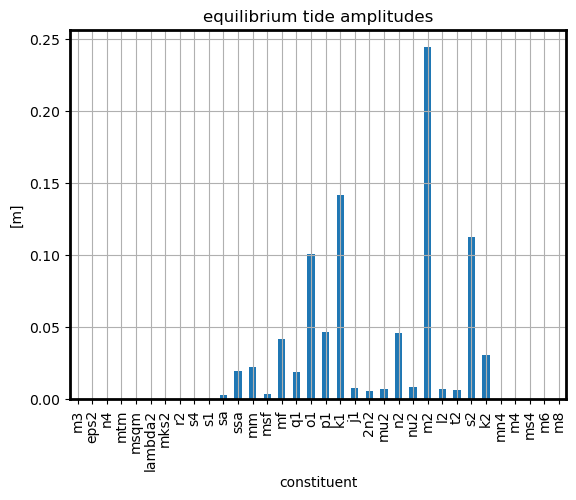
ax = td.cproperties.amplitude.plot.bar()
ax.set_title("equilibrium tide amplitudes")
ax.set_ylabel("[m]")
ax.grid()
fig, axes = plt.subplots(3, 1, figsize=(10, 10))
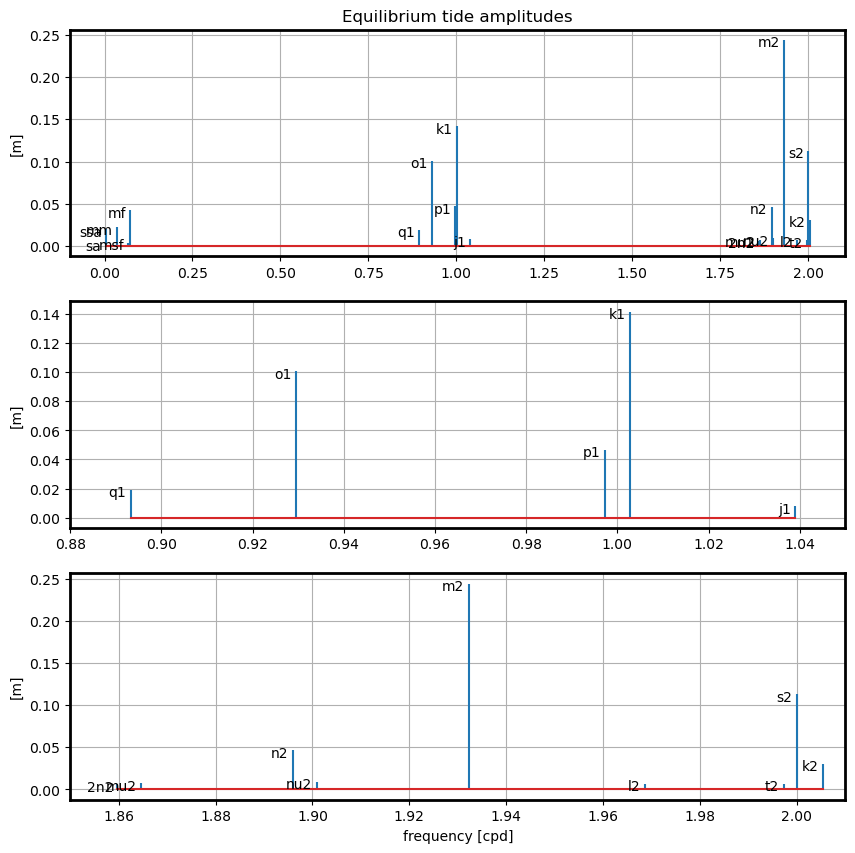
td.plot_equilibrium_amplitudes(td.cproperties, axes[0])
td.plot_equilibrium_amplitudes(td.cproperties, ax=axes[1], xlim=(0.88, 1.05))
td.plot_equilibrium_amplitudes(td.cproperties, ax=axes[2], xlim=(1.85, 2.01))

for i in range(0, 2):
    axes[i].set_xlabel("")
for i in range(1, 3):
    axes[i].set_title("")
play with tidal arguments used for predictions#
$ \begin{align} \eta = \mathcal{R} \Big { \sum_k h_k \times f_k(t) h_c e^{i (g_k(t) + u_k(t) ) } \Big } \end{align} $
$g_k (t)$ is the equilibrium argument, it is common to all models $f_l(t)$ and $u_k(t)$ are nodal corrections.
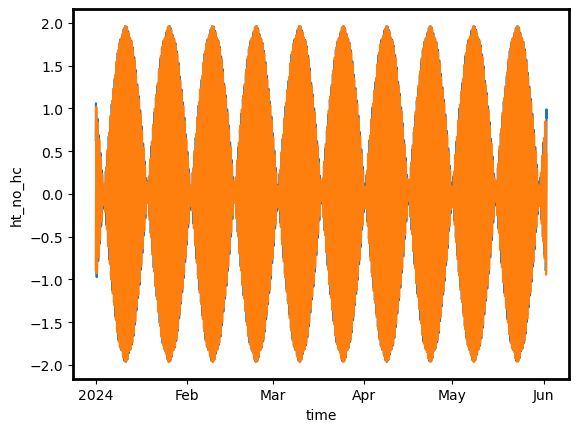
Constituents have unit complex amplitudes here:
ds = td.get_tidal_arguments(time)

_ds = ds
# _ds = ds.isel(time=slice(0,24*28))
np.real(_ds["ht_no_hc"]).sel(constituent=td.major_semidiurnal).sum("constituent").plot()
np.imag(_ds["ht_no_hc"]).sel(constituent=td.major_semidiurnal).sum("constituent").plot()
[<matplotlib.lines.Line2D at 0x14375ea70>]